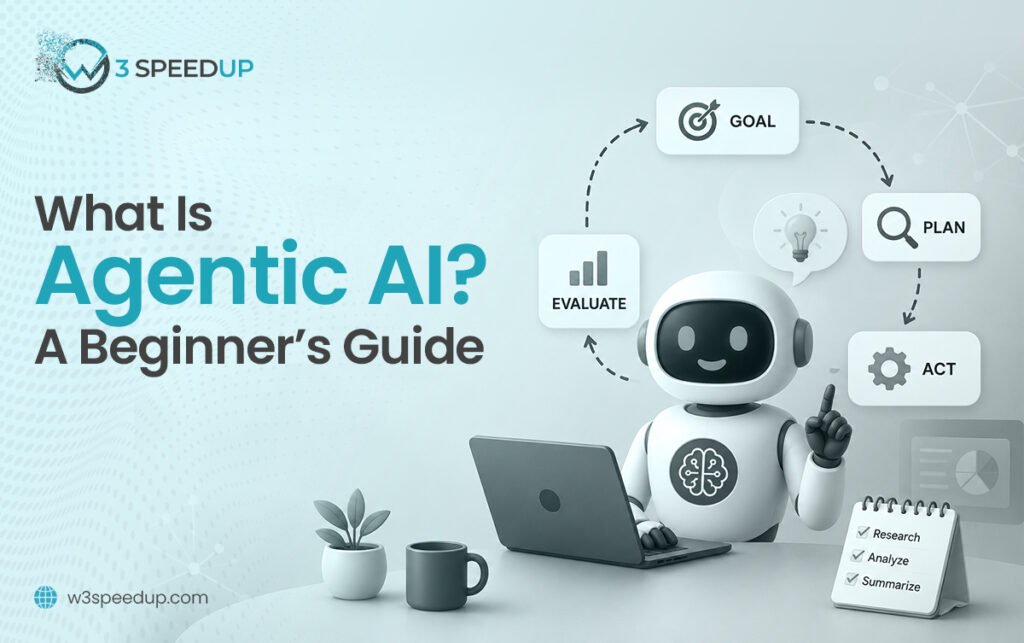
Artificial Intelligence (AI) is, like, evolving very quickly, moving past simple chatbots and predictive tools, into systems that can sorta independently plan, make decisions , and take action. This new generation of AI is usually called Agentic AI. And as businesses plus individuals look for smarter methods to automate tasks and raise productivity, Agentic AI is starting to feel like one of the biggest transformative innovations on the technology side of things.
In this Agentic AI guide, we’ll dig into what is Agentic AI exactly, how it works in practice, what the benefits look like, where we’re already seeing real world uses, and also why many experts think it is actually the future of intelligent automation, not just another trend .
What Is Agentic AI?
Agentic AI basically means AI systems that can do stuff on their own, like autonomously pursue some goal, decide what to do, keep adapting when things shift, and actually execute tasks with very low human involvement.
Instead of older AI models which kind of just react by responding to your prompt, or just analyze data passively, Agentic artificial intelligence works in a more driven way toward an objective. It can plan out multi-step actions, keep an eye on outcomes, and revise its strategy using real-time feedback.
In simple words, if traditional AI answers questions, Agentic AI takes actions, and yeah it does it in a more proactive way too.
Agentic AI Explained
So imagine you ask an AI assistant to handle booking a business trip. A “classic” AI might just spit out flight choices and some hotel suggestions , you know. But an Agentic AI setup can kind of do the whole thing more on its own , as in:
- It can search for flights
- Compare ticket costs
- Actually book the tickets
- Reserve a place to stay
- Drop those times into your calendar
- Send the confirmations
And it does all of that while it keeps adjusting to what you prefer and what budget you set, sometimes even using some pretty related reasoning.
This ability to act independently is basically what makes Agentic AI such a noticeable leap in the whole AI evolution.
How AI Agents Work?
To understand Agentic AI it’s important to understand AI agents, like generally.
An AI agent is a software entity that’s built to:
- Observe its environment
- Analyze what information is there
- Make decisions, and then take actions
- Learn from the outcomes
These more intelligent agents in AI just keep going continuously, they operate on their own, toward predefined goals, instead of sitting around waiting for constant new instructions.
Core Components of Agentic AI
1. Goal-Oriented Planning
Agentic AI starts with a clear objective, and then kind of builds a workable plan to reach it, step by step (or not so step by step, depends).
For example
Goal: Increase customer satisfaction
The system might do things like:
- Analyze customer feedback
- Spot recurring troubles
- Propose alternative remedies
- Carry out automated support replies
2. Autonomous Decision-Making AI
One of the defining characteristics of Agentic AI is that it can make decisions on its own, like without asking around first.
Using advanced reasoning along with some contextual analysis, an autonomous decision making AI can look at a bunch of possible choices, then pick the path that seems most effective or suitable.
3. Memory and Context Awareness
Unlike traditional models that are stuck with a fairly limited context window, Agentic AI systems tend to hold onto memory and get better at handling what happened earlier.
So in practice they can:
- Remember user preferences
- Track project progress
- Improve future decisions
4. Action Execution
Agentic AI can interact with software, databases, APIs, and digital environments to complete tasks.
Examples include:
- Sending emails
- Managing workflows
- Scheduling meetings
- Updating records
Benefits of Agentic AI
Across different industries, organizations are looking into agentic AI because it might boost efficiency and cut down on manual work , you know , with less fuss.
Increased Productivity
Agentic AI can automate repetitive tasks and handle complex workflows, allowing employees to focus on strategic work.
Faster Decision-Making
Through real-time analysis and reasoning, Agentic AI enables quicker and more informed decisions.
Enhanced Scalability
Businesses can manage larger workloads without proportionally increasing staff.
Improved Accuracy
Autonomous AI systems reduce human errors by consistently following optimized processes.
Continuous Learning
Many Agentic AI solutions learn from interactions and improve performance over time.
Examples of Agentic AI
- AI-Powered Customer Support: Answers queries, analyzes customer history, escalates complex issues, and provides personalized recommendations.
- Personal Productivity Assistants: Manage schedules, prioritize tasks, coordinate meetings, and send follow-ups.
- Autonomous Financial Advisors: Monitor investments, analyze market trends, recommend portfolio changes, and execute approved transactions.
- Software Development Agents: Write code, test applications, identify bugs, and deploy updates.
- Supply Chain Optimization: Forecast demand, manage inventory, streamline logistics, and improve operational efficiency.
Agentic systems can monitor inventory, forecast demand, and coordinate logistics with minimal human intervention.
Agentic AI Use Cases Across Industries
| Industry | Key Use Cases |
|---|---|
| Healthcare | Patient scheduling, treatment recommendations, medical data analysis, and administrative automation. |
| Finance | Fraud detection, risk assessment, compliance monitoring, and automated reporting. |
| E-commerce | Personalized recommendations, inventory management, pricing optimization, and customer support. |
| Manufacturing | Predictive maintenance, automated quality control, and production planning. |
| Human Resources | Candidate screening, interview scheduling, employee onboarding, and performance tracking. |
Multi-Agent Systems: The Next Level of AI Collaboration
An exciting development in Agentic AI is the emergence of multi-agent systems.
Rather than just one AI agent doing everything by itself, you can have several specialized agents that sort of work together , toward the same overall aim. And honestly that’s where it gets interesting.
For example, a marketing campaign might involve
- Research Agent
- Content Agent
- SEO Agent
- Analytics Agent
- Campaign Management Agent
Each agent does a focused role, but they also keep in touch with the others, like coordination in the background, you know.
This kind of shared effort tends to boost efficiency, scaling, and overall problem-solving abilities.
Challenges and Risks of Agentic AI
Despite its promise, Agentic AI introduces several challenges.
| Challenge | Description |
|---|---|
| Governance & Control | Ensure AI agents operate within defined boundaries and organizational policies. |
| Security Concerns | Implement strong cybersecurity measures to prevent misuse, breaches, and unauthorized access. |
| Ethical Considerations | Maintain transparency, fairness, accountability, and responsible AI decision-making. |
| Reliability | Continuously monitor and evaluate AI agents to ensure consistent and intended performance. |
If we want responsible adoption, addressing these concerns is really essential, and it’s not optional, not in the long run.
The Future of AI Agents
The future of AI agents is expected to bring even more autonomy, intelligence, and sort of collaboration too, though not always in the obvious way.
In the mix you can already see a few emerging trends, like:
- More advanced reasoning strength
- Better multi-agent ecosystems
- Deeper personalization, tailored to what someone is doing
- Stronger memory and improved awareness of context
- Tighter integration across different business platforms, and even routine productivity apps
As next generation AI technology keeps evolving, Agentic AI might turn into a normal part of everyday business work and personal productivity tools, kinda like a quiet baseline.
Industry analysts also think that autonomous AI systems will increasingly deal with complex workflows that today still need human supervision, and that this will trigger a fresh era of intelligent automation.
Conclusion
Agentic AI is redefining the future of artificial intelligence by enabling systems to act autonomously, make intelligent decisions, and achieve goals with minimal human intervention. By combining advanced reasoning, planning, and execution capabilities, Agentic artificial intelligence goes far beyond traditional AI models.
Whether through AI-powered assistants, AI workflow automation, multi-agent systems, or enterprise applications, Agentic AI is poised to become one of the most influential technologies of the coming decade.
For anyone looking to understand the next wave of innovation, this provides a strong foundation for exploring one of the most exciting developments in the world of AI.
FAQs About Agentic AI
Q1. What is Agentic AI?
Agentic AI is a type of AI that can independently plan, make decisions, and perform tasks to achieve specific goals.
Q2. How does Agentic AI differ from traditional AI?
Traditional AI responds to prompts, while Agentic AI can take autonomous actions and execute multi-step workflows.
Q3. What are common Agentic AI applications?
Examples include customer support, productivity assistants, financial advisory systems, software development, and supply chain management.
Q4. Which industries use Agentic AI?
Healthcare, finance, e-commerce, manufacturing, and human resources are among the leading adopters.
Q5. What challenges does Agentic AI face?
Key concerns include security, governance, ethics, transparency, accountability, and ensuring reliable performance.